FEB
13
2026
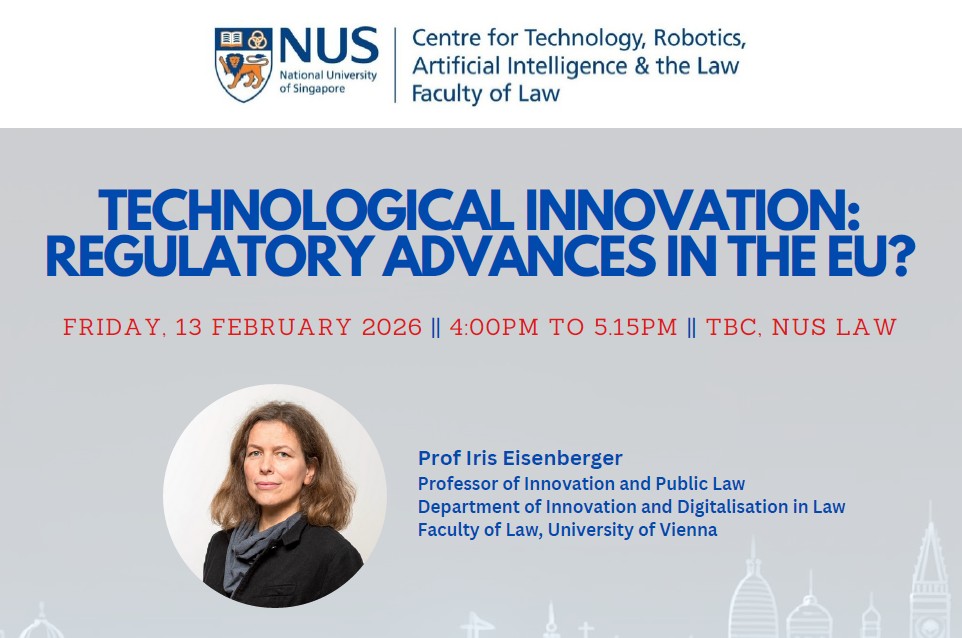
Technological Innovation: Regulatory Advances in the EU?





Description
The European Union (EU) has developed a multifaceted approach to regulating emerging technologies such as artificial intelligence (AI), robotics, biotechnology, and nanotechnology. The EU employs diverse regulatory models — including ex ante, ex post, post error approaches; product-, process-, or rights-based regulation; and state- or market-driven product approval — involving EU institutions, nation states, agencies, standardisation bodies, and private entities.
This talk critically examines how these risk management frameworks — particularly under the EU AI Act — influence innovation dynamics and access to markets. The Act integrates established regulatory tools such as command-and-control mechanisms, conformity assessments, and fundamental rights impact assessments, enabling both qualitative and quantitative risk analysis. However, the embedded risk management system may disproportionately favor Big Tech over small and medium-sized enterprises (SMEs) and start-ups, due to significant resource asymmetries in compliance costs, participation in standard-setting, and access to legal and technical expertise.
To address this imbalance, the talk proposes that state-provided digital infrastructure, knowledge-sharing platforms, talent pooling initiatives, and inclusive governance models could foster a more level playing field. These insights are particularly relevant for Southeast Asia, where emerging AI ecosystems face similar challenges.
ABOUT THE SPEAKER
Prof. Iris Eisenberger is Professor of Innovation and Public Law at the Department of Innovation and Digitalisation in Law at the Faculty of Law (University of Vienna). Her work focuses on innovation and technology law, the protection of fundamental and human rights and research at the intersection of law, innovation and society.
She studied law at the University of Graz, Austria and the Universidad de Valladolid, Spain, and political theory at the London School of Economics and Political Science, England before obtaining her venia docendi in the field of constitutional law, administrative law and the related fields of European Union law at the Faculty of Law at the University of Vienna, Austria.
She worked for the Austrian Parliament and the European Parliament as well as for the Constitutional Service of the Austrian Federal Chancellery. She held visiting positions at numerous renowned universities including the European University Institute in Florence (Italy), the University of Freiburg (Germany), Harvard University (U.S.), the Mekelle University (Ethiopia), the Jigme Singye Wangchuck School of Law (Bhutan), the Macau University (China), the Technical University Munich (Germany) and the Stanford University (U.S.).
TERMS AND CONDITIONS
1. Fees (if applicable) are to be paid before the commencement of the event with exception of e-invoices.
2. Fees paid are non-refundable.
3. Registration is transferable within the same organisation if the request is made at least one week in advance of the event.
4. By filling up this Registration Form,
i. Participants agree and consent that their personal data provided in this form may be collected, used, processed and disclosed by NUS and the event organisers for the purposes of processing their registration, in accordance with the Personal Data Protection Act 2012 and all subsidiary legislation related thereto. In respect to disclosure, NUS may disclose participants personal data to third parties (which may be in or outside of Singapore) where necessary for such purposes.
ii. Participants will also consent to NUS taking photographs and videos for the purposes of event reporting, marketing, publicity, and media/social media. Participants further consent to NUS disclosing such photographs and videos to third party media entities (whether in Singapore or otherwise) for publicity purposes and NUS may identify them by name.
iii. NUS Law School and designated event organisers reserve the right to alter any of the programme or other arrangements for this event, including cancellation or postponement of the event, should circumstances so warrant.
Date and Time
Friday, 13th February 2026 4:00PM GMT+08:00
to
Friday, 13th February 2026 5:15PM GMT+08:00
Organisation
Faculty of Law
Location
TBC, NUS Kent Ridge Campus