SEP
19
2024
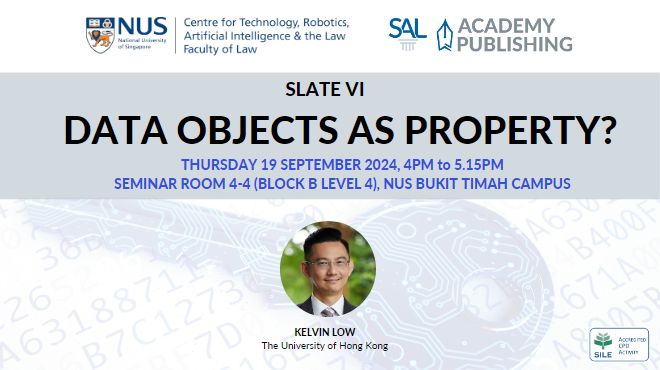
SLATE VI: Data Objects as Property?





Description
English academics have belatedly awoken to the challenge to the law posed by the computer revolution that started in the late twentieth century. Inspired by American jurisprudence, technophile lawyers unfamiliar with the complexities of conceptualising property liberally propose to extend property law concepts to digital files, including a recent attempt to do so by postulating a three-layer model of digital files to enable ‘ownership’ at the logical layer. Meanwhile, American academics, facing some resistance in the courts, have continued to propound the case for data property. This seminar exposes the many dangers of the concept of property within the common law, the failures of recent proposals on both sides of the Atlantic to address the underlying technical workings of computing, and the perils that such ill-considered extensions of property will pose to legal development.
ABOUT THE SPEAKER
Kelvin F.K. Low read law at the National University of Singapore and Oxford University. Before his current appointment at the University of Hong Kong, he held previous appointments at National University of Singapore, Singapore Management University, and City University of Hong Kong. His research interest spans the field of private law but with a particular interest in property, broadly defined. He has published internationally with leading journals such as the American Journal of Comparative Law, the International & Comparative Law Quarterly, Legal Studies, Lloyd’s Maritime and Commercial Law Quarterly, the Law Quarterly Review, the Melbourne University Law Review, and the Modern Law Review. He is a co-author (together with Michael Bridge, Louise Gullifer, and Gerard McMeel) of the 2nd and 3rd editions of The Law of Personal Property, and co-author (together with Tang Hang Wu) of the 3rd and 4th editions of Tan Sook Yee’s Principles of Singapore Land Law. His works have been cited by the courts in Australia, Canada, England and Wales, Hong Kong SAR, Malaysia, New Zealand, and Singapore as well as law commissions and law reform bodies in Australia, England and Wales, Ireland, New Zealand, Scotland, and Singapore.
Terms and Conditions
1. Fees are to be paid before the commencement of the event with exception of e-invoices.
2. Fees paid are non-refundable.
3. Registration is transferable within the same organisation if the request is made at least one week in advance of the event.
4. By filling up this Registration Form,
i. Participants agree and consent that their personal data provided in this form may be collected, used, processed and disclosed by NUS and the event organisers for the purposes of processing their registration, in accordance with the Personal Data Protection Act 2012 and all subsidiary legislation related thereto. In respect to disclosure, NUS may disclose participants personal data to third parties (which may be in or outside of Singapore) where necessary for such purposes.
ii. Participants will also consent to NUS taking photographs and videos for the purposes of event reporting, marketing, publicity, and media/social media. Participants further consent to NUS disclosing such photographs and videos to third party media entities (whether in Singapore or otherwise) for publicity purposes and NUS may identify them by name.
iii. NUS Law School and designated event organisers reserve the right to alter any of the programme or other arrangements for this event, including cancellation or postponement of the event, should circumstances so warrant.
Date and Time
Thursday, 19th September 2024 4:00PM GMT+08:00
to
Thursday, 19th September 2024 5:15PM GMT+08:00
Organisation
Faculty of Law
Contact Email
trail@nus.edu.sg
Location
Seminar Room 4-4 (Block B Level 4), NUS Bukit Timah Campus, 469 Bukit Timah Road