AUG
1
2024
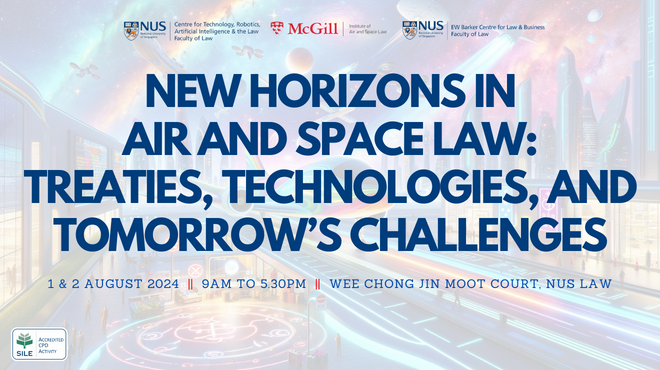
New Horizons in Air and Space Law





Description
Synopsis
Advanced supersonic aircraft, remotely-piloted cargo drones, and even flying taxis are on the horizon. But all these developments necessitate a reevaluation of traditional air law. As these technology developments redefine our relationship with the skies above, the need for robust and forward-thinking legal frameworks becomes increasingly urgent to ensure safe, equitable, and sustainable use of airspace. Similarly, space, once the exclusive realm of governmental agencies, is now a vibrant theatre of commercial opportunities, with private companies leading the charge in space travel and exploration. This new era is marked by rapid technological innovation, from reusable rockets to advanced satellite constellations offering global connectivity, signalling a shift towards more accessible and economically driven space ventures. These developments, from asteroid mining to lunar tourism, suggest vast commercial potential. But they also bring to the fore crucial questions of international law and space governance.
Amid this rapidly evolving commercial landscape, technology means that air and space domains are increasingly converging – indeed, spaceplanes are set to elide the practical differences between air and space altogether.
The Centre for Technology, Robotics, Artificial Intelligence and the Law and the EW Barker Centre for Law and Business, both of the Faculty of Law, National University of Singapore, and the Institute of Air and Space Law, of the Faculty of Law, McGill University, will be jointly organizing a conference with the theme “New Horizons in Air and Space Law: Treaties, Technologies, and Tomorrow’s Challenges.”
This conference aims to facilitate discussion that encompasses the entire gamut of legal and policy issues associated with our new air and space ages. This conference builds on previous collaborations between NUS and McGill, and will be relevant for governmental officials, academics, practising lawyers, in-house counsel, regulators, academics, law students and the broader aerospace community. The conference will be conducted physically, on the grounds of the NUS Bukit Timah Campus.
Structure
The conference will span two days, with each day featuring two speaker presentations and four thematic panels. Each speaker will also moderate the panel that directly follows their presentation, with additional expert moderation provided by NUS and McGill staff and invited guests. Panellists will be a mix of specifically invited experts and panellists selected from abstracts submitted in response to an open call for papers. Panels will be organized thematically, based on the abstracts received, and panellists are required to submit a full and complete paper prior to the conference.
TERMS AND CONDITIONS
1. Fees are to be paid before the commencement of the event with exception of e-invoices.
2. Fees paid are non-refundable.
3. Registration is transferable within the same organisation if the request is made at least one week in advance of the event.
4. Please choose the Session(s) you would like to attend. No changes can be made after selection of Sessions.
5. By filling up this Registration Form,
i. Participants agree and consent that their personal data provided in this form may be collected, used, processed and disclosed by NUS and the event organisers for the purposes of processing their registration, in accordance with the Personal Data Protection Act 2012 and all subsidiary legislation related thereto. In respect to disclosure, NUS may disclose participants personal data to third parties (which may be in or outside of Singapore) where necessary for such purposes.
ii. Participants will also consent to NUS taking photographs and videos for the purposes of event reporting, marketing, publicity, and media/social media. Participants further consent to NUS disclosing such photographs and videos to third party media entities (whether in Singapore or otherwise) for publicity purposes and NUS may identify them by name.
iii. NUS Law School and designated event organisers reserve the right to alter any of the programme or other arrangements for this event, including cancellation or postponement of the event, should circumstances so warrant.
Date and Time
Thursday, 1st August 2024 9:30AM GMT+08:00
to
Friday, 2nd August 2024 4:30PM GMT+08:00
Organisation
Faculty of Law
Contact Email
trail@nus.edu.sg
Location
Wee Chong Jin Moot Court (Block B Level 1), NUS Bukit Timah Campus, 469 Bukit Timah Road