NOV
5
2026
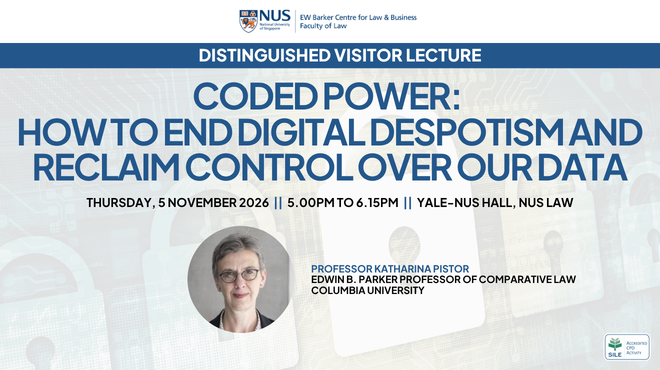
Distinguished Visitor Lecture by Prof Katharina Pistor





Description
“Coded power” is the power over the formal means by which societies organize themselves. It can take the form of law (law is code) or digital code (code is law). Coded power is employed to advance the interests of the coders, not (necessarily) others who depend on the code. Legally coded power dates back centuries, if not millennia. Digital coded power is of more recent vintage; its source is the control over data that is produced as people go about their lives, especially on the internet. Its full impact on societies and the well-being of their members is only now becoming more apparent. Despite all the potential to do good by connecting people from far flung places, digitally coded power has helped fragment societies, pitch people against one another, and erode social cohesion. Digital despotism is not inevitable; it all depends on how we use the powers of the digital code. The road from digital serfdom runs through participatory or joint data governance, not individual rights, including privacy. This lecture offers examples for how data co-creators can pool data and create governance structures in legal and digital codes to control access and use as they wish and in this way turn data despots into their clients.
SPEAKER BIO
Katharina Pistor is a leading scholar and writer on corporate governance, money and finance, property rights, and comparative law and legal institutions.
She is the author or co-author of nine books. Forthcoming from Yale University Press, The Law of Capitalism and How to Transform It, offers a study of the legal underpinnings of capitalism, reasons why the system must be transformed, and actions we can take. Her previous book, The Code of Capital: How the Law Creates Wealth and Inequality, examines how assets such as land, private debt, business organizations, or knowledge are transformed into capital through contract law, property rights, collateral law, and trust, corporate, and bankruptcy law. The Code of Capital was named one of the best books of 2019 by the Financial Times and Business Insider.
Pistor publishes widely in legal and social science journals. In her essay “From Territorial to Monetary Sovereignty” in the Journal on Theoretical Inquiries in Law (2017), she argued that the rise of a global money system means a new definition of sovereignty: the control of money. She has served on the editorial boards of the American Journal of Comparative Law, Columbia Journal of European Law, European Business Organization Law Review, and Journal of Institutional Economics.
Pistor is a prominent commentator on cryptocurrency and has testified before Congress on the lack of regulatory oversight of proposed international cryptocurrencies. As the director of the Center on Global Legal Transformation, Pistor directs the center’s work to develop research projects and organize conferences to examine ways in which law shapes global relations and how they, in turn, transform the law.
Before joining Columbia Law School in 2001, Pistor held teaching and research positions at Harvard Law School, the Harvard Kennedy School, and the Max Planck Institute for Foreign and International Law in Hamburg. She has been a visiting professor at the University of Pennsylvania Carey Law School, New York University School of Law, Frankfurt University, London School of Economics, and Oxford University.
She is a research associate with the Centre for Economic Policy Research, and she has served as principal investigator of the Global Finance and Law Initiative (2011–2013). Pistor was a member of the board of directors (2011–2014) and a fellow (2019) of the European Corporate Governance Institute. In 2015, she was elected a member of the Berlin-Brandenburg Academy of Sciences and Humanities, and in 2021, she was elected a member of the European Academy of Sciences.
In 2012 she was co-recipient (with Martin Hellwig) of the Max Planck Research Award on international financial regulation, and in 2014, she received the Allen & Overy Prize for best working paper on law of the European Corporation Governance Institute. She is also the recipient of research grants by the Institute for New Economic Thinking and the National Science Foundation.
TERMS AND CONDITIONS
1. Fees (where applicable) are to be paid before the commencement of the event with exception of e-invoices.
2. Fees paid are non-refundable.
3. Registration is transferable within the same organisation if the request is made at least one week in advance of the event.
4. By filling up this Registration Form,
i. Participants agree and consent that their personal data provided in this form may be collected, used, processed and disclosed by NUS and the event organisers for the purposes of processing their registration, in accordance with the Personal Data Protection Act 2012 and all subsidiary legislation related thereto. In respect to disclosure, NUS may disclose participants personal data to third parties (which may be in or outside of Singapore) where necessary for such purposes.
ii. Participants will also consent to NUS taking photographs and videos for the purposes of event reporting, marketing, publicity, and media/social media. Participants further consent to NUS disclosing such photographs and videos to third party media entities (whether in Singapore or otherwise) for publicity purposes and NUS may identify them by name.
iii. NUS Faculty of Law and designated event organisers reserve the right to alter any of the programme or other arrangements for this event, including cancellation or postponement of the event, should circumstances so warrant.
Date and Time
Thursday, 5th November 2026 5:00PM GMT+08:00
to
Thursday, 5th November 2026 6:15PM GMT+08:00
Organisation
Faculty of Law
Contact Email
ewbclb@nus.edu.sg
Location
Yale-NUS Hall, NUS UTown, 18 College Ave West