JUN
3
2025
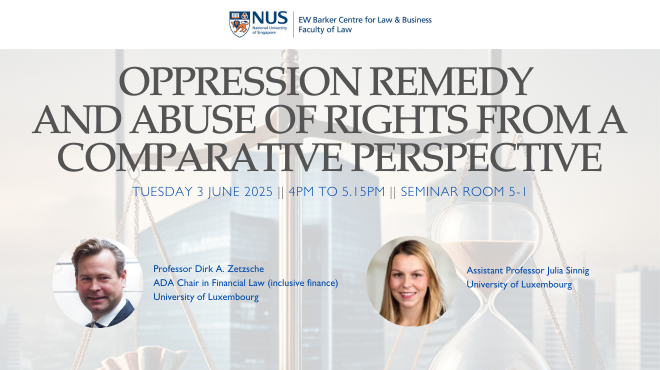
Oppression Remedy and Abuse of Rights





Description
The oppression remedy is the all-encompassing shareholder remedy in Common Law countries, granting standing to sue to shareholders, debtholders and other complainants for apparently oppressive, unfair conduct, in particular by majority shareholders. In Civil Law countries, a combination of statutory shareholder actions, fiduciary duties of majority shareholders, a general abuse of rights doctrine, and tort law / law of delict serves a similar function to protect against over-stepping conduct of majority shareholders.
In two presentations Prof. Zetzsche and Prof. Sinnig from the University of Luxembourg discuss the oppression remedy / abuse of rights doctrine from a comparative company law perspective,
The first presentation “A Comparative View on the Majority’s Oppression and Abuse of Rights” delineates the scope of the legal instruments governing oppression / abuse cases: corporate law instruments apply to direct shareholder relationships, while abuse of rights and general tort law are meaningful in corporate groups and non-shareholder settings. Besides defining which conduct is abusive, defining the damage to be compensated poses a major challenge in all abuse / oppression cases as long as the company is a going concern.
The second presentation “Abuse and Oppressive Conduct by Majority Shareholders: lessons from Luxembourg, Belgium and France” discusses the statutory and case law on shareholder actions and argues that Luxembourg and Belgian courts apply a restrictive approach to abuse claims. Directors’ liability compensates for the restrictive approach to abuse claims in these jurisdictions.
Terms and Conditions
1. Fees are to be paid before the commencement of the event with exception of e-invoices.
2. Fees paid are non-refundable.
3. Registration is transferable within the same organisation if the request is made at least one week in advance of the event.
4. By filling up this Registration Form,
i. Participants agree and consent that their personal data provided in this form may be collected, used, processed and disclosed by NUS and the event organisers for the purposes of processing their registration, in accordance with the Personal Data Protection Act 2012 and all subsidiary legislation related thereto. In respect to disclosure, NUS may disclose participants personal data to third parties (which may be in or outside of Singapore) where necessary for such purposes.
ii. Participants will also consent to NUS taking photographs and videos for the purposes of event reporting, marketing, publicity, and media/social media. Participants further consent to NUS disclosing such photographs and videos to third party media entities (whether in Singapore or otherwise) for publicity purposes and NUS may identify them by name.
iii. NUS Law School and designated event organisers reserve the right to alter any of the programme or other arrangements for this event, including cancellation or postponement of the event, should circumstances so warrant.
Date and Time
Tuesday, 3rd June 2025 4:00PM GMT+08:00
to
Tuesday, 3rd June 2025 5:15PM GMT+08:00
Organisation
Faculty of Law
Contact Email
ewbclb@nus.edu.sg
Location
Seminar Room 5-1 (Block B, Level 5), NUS Bukit Timah Campus, 469 Bukit Timah Road