APR
8
2025
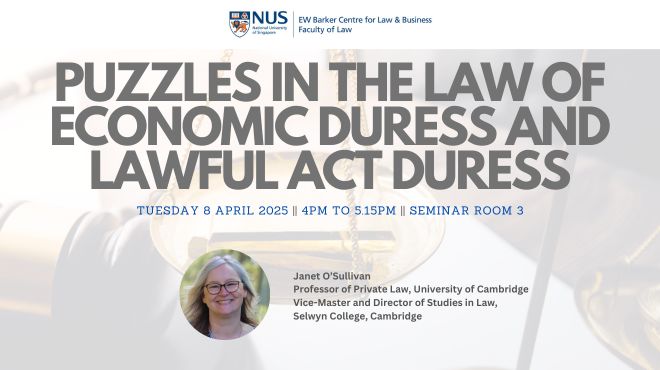
Puzzles in the Law of Economic Duress and Lawful Act Duress





Description
Despite two recent UK Supreme Court decisions, several fundamental puzzles remain in the law of economic duress and so-called ‘lawful act duress’. Economic duress is plagued by terminological ambiguity, leading to substantive confusion. In particular, judges and commentators have elided three separate requirements, namely (i) an illegitimate threat, that (ii) subjectively caused the claimant to contract, where (iii) objectively there was no reasonable alternative. Thus we find judges opining that, ‘not every threat to breach a contract is illegitimate’, when on closer examination they mean ‘not every threat to breach a contract meets conditions (ii) and (iii).’ This in turn has led to the suggestion that it might be legitimate to threaten to breach a contract (ruling out a finding of economic duress), even where conditions (ii) and (iii) are met, for example if the defendant was acting ‘bona fide’ or for ‘reasonable motives’. This seminar will address this suggestion, and demonstrate that it is muddled, and unfortunate in undermining contractual rights and the need for precision in legal reasoning. Similarly, despite the seminal decision of the UK Supreme Court in Pakistan International Airline Corporation v Times Travel (UK) Ltd (2021) on so-called ‘lawful act duress’, uncertainties remain – are the two examples given in the majority judgment exhaustive of the concept, or merely illustrations? What is the difference between ‘highly reprehensible’ conduct and ‘bad faith’, particularly in the context of gross disparity of bargaining power? The UK Justices referred in detail Singaporean law – can it help provide the answers?
ABOUT THE SPEAKER
Janet O’Sullivan is a Professor of Private Law, University of Cambridge, and is Vice-Master and Director of Studies in Law at Selwyn College, Cambridge. She gained a triple first in Law as an undergraduate in Cambridge, graduating first in her year in 1988 and receiving several university prizes. She practised as a commercial solicitor with Slaughter and May after graduating, before returning to Cambridge to take up a teaching fellowship at Selwyn in 1994 and a lectureship in the Law Faculty two years later. In 2005 she was awarded the Pilkington Teaching Prize for excellence in university teaching. She specialises in the Law of Contract and the Law of Tort, in particular the intersection of the two, concurrent liability and professional negligence, and has published extensively in these areas, with articles in leading journals including the Law Quarterly Review and the Cambridge Law Journal, and numerous edited collections. Janet is the author of a very successful OUP textbook on the Law of Contract, now in its eleventh edition. Last year she organised a highly successful symposium to mark the 25th anniversary of the Contract (Rights of Third Parties) Act 1999. She has three adult children, one of whom has Down syndrome, and lives in North Essex.
Terms and Conditions
1. Fees are to be paid before the commencement of the event with exception of e-invoices.
2. Fees paid are non-refundable.
3. Registration is transferable within the same organisation if the request is made at least one week in advance of the event.
4. By filling up this Registration Form,
i. Participants agree and consent that their personal data provided in this form may be collected, used, processed and disclosed by NUS and the event organisers for the purposes of processing their registration, in accordance with the Personal Data Protection Act 2012 and all subsidiary legislation related thereto. In respect to disclosure, NUS may disclose participants personal data to third parties (which may be in or outside of Singapore) where necessary for such purposes.
ii. Participants will also consent to NUS taking photographs and videos for the purposes of event reporting, marketing, publicity, and media/social media. Participants further consent to NUS disclosing such photographs and videos to third party media entities (whether in Singapore or otherwise) for publicity purposes and NUS may identify them by name.
iii. NUS Law School and designated event organisers reserve the right to alter any of the programme or other arrangements for this event, including cancellation or postponement of the event, should circumstances so warrant.
Date and Time
Tuesday, 8th April 2025 4:00PM GMT+08:00
to
Tuesday, 8th April 2025 5:15PM GMT+08:00
Organisation
Faculty of Law
Contact Email
ewbclb@nus.edu.sg
Location
Seminar Room 3 (Block B, Level 3), NUS Bukit Timah Campus, 469 Bukit Timah Road