






SEP
17
2026
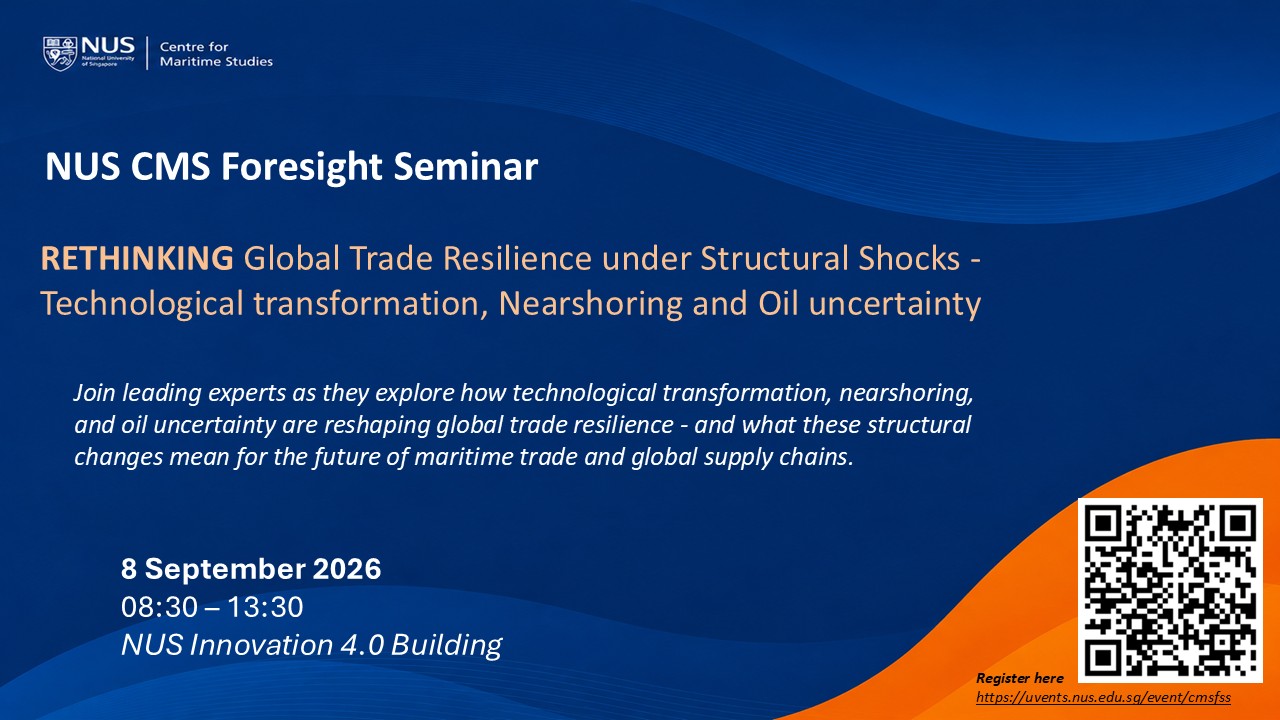
CMS Maritime ReDi Forum and Foresight Seminar
Total Registrations: 124
Description
As part of the Maritime and Digitalisation Initiative (ReDi) and the NOL Fellowship, this seminar brings together leading experts from academia, industry, and government to examine the structural forces reshaping global trade.
Our Distinguished Guest Speakers
Hear from our distinguished guest speakers as they share their perspectives on the critical forces shaping the future of global trade and maritime logistics:
• Technology Transformation – Exploring how digital technologies and innovation are transforming the future of maritime trade and logistics
• Reshoring – Understanding how regionalised production networks are reshaping global trade and maritime connectivity
• Oil Price Uncertainties – Examining the impact of volatile energy prices on shipping and trade
Mr Bo Wegener
CEO, Asia Pacific
CMA CGM
Navigating Volatility: How Energy and Geopolitics are Reshaping Shipping and Supply Chains
As one of the world’s largest shipping and logistics groups, CMA CGM feels the direct impact of volatile energy prices and shifting global politics on how goods move around the world. This session examines the structural forces reshaping Asia-Pacific trade and what they mean for the maritime industry. From fleet and network decisions, diversifying energy mix across LNG, biofuels and e-fuels, and the growing role of AI and digitalisation in building resilience. It concludes with a carrier’s take on what to do about it.
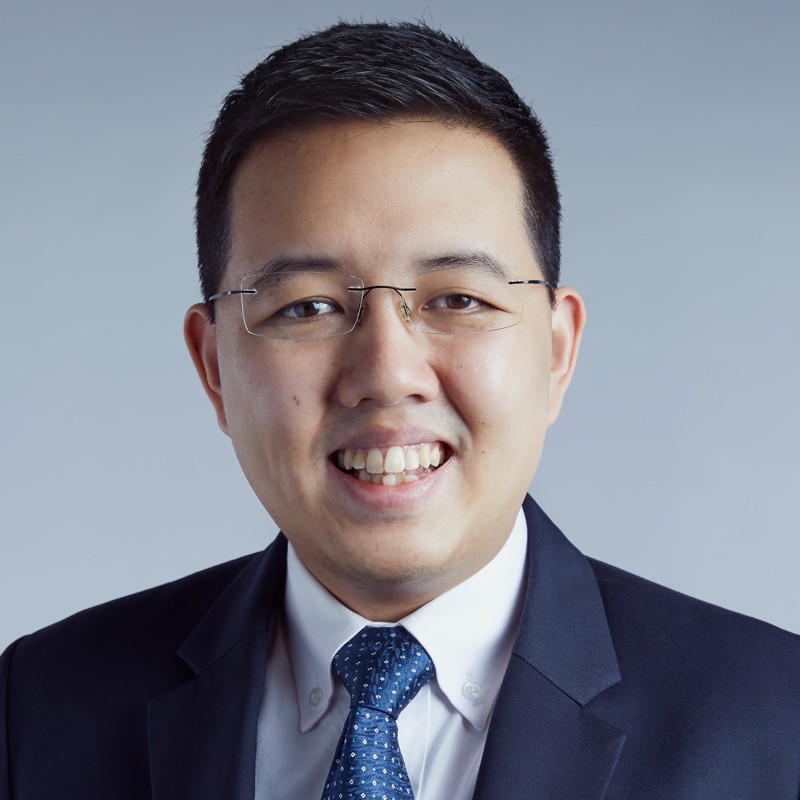
Mr Victor Sim
Director, Supply Chain and Logistics Resilience
Enterprise Singapore
The Evolution of Global Supply Chains in a Changing World
The global landscape is undergoing profound transformation, driven by shifting geopolitical dynamics, rapid technological advancements, and the rise of new economic centres. Businesses are diversifying their import and export networks to enhance resilience, while digital technologies are providing unprecedented situational awareness and enabling real-time orchestration across increasingly complex operations. At the same time, emerging growth markets are reshaping global trade flows and creating new opportunities for investment and collaboration.
These changes are fundamentally redefining supply chains. Modern supply chains are becoming longer in geographical reach but shorter in individual segments, reflecting a more distributed and specialised production ecosystem. They are evolving from linear networks into intricate webs of manufacturing, consolidation, and distribution hubs spanning multiple countries and regions. Beyond the movement of goods, supply chains are increasingly integrating manufacturing, assembly, and product value-add activities closer to key markets.

Dr Chen Xinwei
Deputy Executive Director
Singapore Maritime Institute
Built for the Storm: How Singapore’s Maritime R&D Is Anchoring Maritime Resilience
The storm is no longer a future scenario — it is the operating environment, with technological shifts rewriting how ports and ships run, supply chains regionalising and reshoring redrawing long-standing routes, and
energy volatility injecting fresh uncertainty into maritime connectivity. Resilience cannot be improvised but must be engineered; drawing on the 2026 Maritime Technology & Research Roadmap and SMI’s latest R&D execution
priorities, this presentation shows how Singapore is moving from reactive adaptation to deliberate design through autonomous port operations, smart shipping, alternative-energy readiness and integrated port services, while revealing how SMI bridges academia, government and industry to translate research into real operational outcomes. The next era of maritime resilience will not be discovered by accident; it will be built, tested and scaled, and this is how Singapore’s maritime R&D is anchoring the system so that when the next shock hits, the foundations hold.

Mr Jimmy Suroto Huang
Founder
Nava Analytics & Research Pte Ltd
Decoding the Impact of Disruptions on Container Shipping & Predicting Future Trends: Insights through Predictive Analytics
The presentation aims to show how Predictive Analytics in container shipping can serve not just as valuable business intelligence for strategic decisions (prescriptions), but to also explain and even quantify the impact of disruptions to the industry. This provides crucial foresight for future trends, and the necessary input for enhanced modelling to cater for the very impact of those disruptions themselves.
This evolution has also accelerated the importance of supply chain orchestrators, which leverage digital capabilities and multi-modal expertise to orchestrate end-to-end global supply chains across multiple logistics partners. In this increasingly interconnected environment, trusted and neutral hubs such as Singapore play a pivotal role by providing the reliability, connectivity, regulatory certainty, and ecosystem needed for businesses to manage complexity and build resilient, future-ready supply chains.
Turning Insights into Foresight...
Following the guest presentations, participants will join facilitated foresight breakout sessions to explore how emerging disruptions could redefine global trade and shipping, and what these shifts may mean for maritime connectivity, supply chain resilience, how diversification is reshaping global trade and maritime connectivity, and the strategic implications for future policy and business decisions.
.jpg)
Date and Time
Thursday, 17th September 2026 8:30AM GMT+08:00
to
Thursday, 17th September 2026 2:00PM GMT+08:00
Organisation
Centre for Maritime Studies
Contact Email
jteo@nus.edu.sg
Our Event Speakers
Bo Wegener
Victor Sim
Chen Xinwei
Jimmy Suroto Huang

Schedule
- 17/09/2026 08:30Registration
- 17/09/2026 09:00Welcome Address
- 17/09/2026 09:05Opening Address
- 17/09/2026 09:15Guest Speakers
- 17/09/2026 10:45Networking Tea Break
- 17/09/2026 11:15Sharing and discussions on Round 1 foresight survey results
- 17/09/2026 12:00Round 2 foresight survey
- 17/09/2026 12:15Trade Shock Modelling and Scenario Analysis by Dr Keramat Hasani (Centre for Maritime Studies)
- 17/09/2026 12:40Closing Address
- 03/09/2026 12:45Networking Lunch