JAN
30
2024
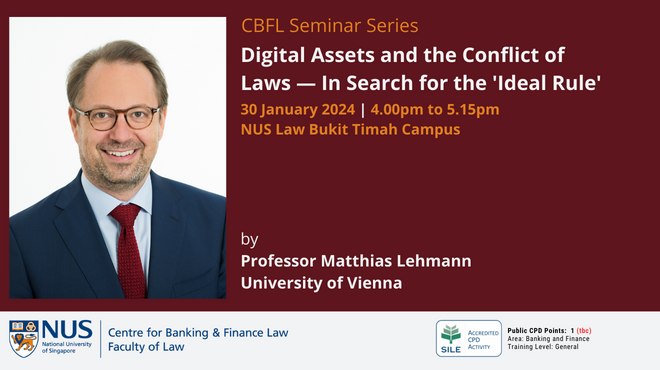
CBFL Seminar Series: Digital Assets and the Conflict of Laws





Description
Which law governs private disputes over assets recorded on the blockchain, such as Bitcoin, Ether or stablecoins? This question has long eluded legal academia and practice. Now, states have begun to enact hard and fast rules. In this seminar, I will compare legislative provisions and judicial rulings from the US, England, Germany, Switzerland, and Liechtenstein, as well as the recently adopted UNIDROIT Principles on Digital Assets and Private Law.
My analysis shows a new emerging gulf in the conflict of laws because of the law governing blockchain assets being determined in different ways. This risks undermining even further the functioning of the crypto economy. That is why I suggest a novel approach.
To this end, I will distil from the various national and international approaches an ‘ideal’ conflict-of-laws rule, which can serve as a blueprint for national legislators and/or courts. The hope is that this may lead to more consensus around the world on the law governing digital assets. This is dearly needed if the blockchain is to fulfil its promise as a trusted storage of value, a catalyst of global commerce, and a means of furthering financial inclusion.
About the Speaker
Matthias Lehmann is a full professor for private law, private international and comparative law at the University of Vienna (Austria), as well as professor for European and comparative business law at the University of Nijmegen (Netherlands). His main interest lies in international and comparative aspects of financial law. He is regularly invited as a guest professor at the Sorbonne University (France), the University of Fribourg (Switzerland), and the Universidad Pablo de Olavide (Spain). Matthias is a member of the Council of the European Law Institute (ELI), of the American Law Institute (ALI), of the Academia Europaea (AE), of the Academic Board of the European Banking Institute (EBI), and of the International Academy of Comparative Law (IACL). He has been visiting the London School of Economics, Oxford University, Stanford University, and is now visiting the National University of Singapore. Matthias has participated in the European Commission’s Expert Group on Conflict of Laws Regarding Securities and Claims and in various UNIDROIT Working Groups, inter alia the one on Digital Assets and Private Law.
TERMS AND CONDITIONS
1. Fees are to be paid before the commencement of the event with exception of e-invoices.
2. Fees paid are non-refundable.
3. Registration is transferable within the same organisation if the request is made at least one week in advance of the event.
4. By filling up this Registration Form,
i. Participants agree and consent that their personal data provided in this form may be collected, used, processed and disclosed by NUS and the event organisers for the purposes of processing their registration, in accordance with the Personal Data Protection Act 2012 and all subsidiary legislation related thereto. In respect to disclosure, NUS may disclose participants personal data to third parties (which may be in or outside of Singapore) where necessary for such purposes.
ii. Participants will also consent to NUS taking photographs and videos for the purposes of event reporting, marketing, publicity, and media/social media. Participants further consent to NUS disclosing such photographs and videos to third party media entities (whether in Singapore or otherwise) for publicity purposes and NUS may identify them by name.
iii. NUS Law School and designated event organisers reserve the right to alter any of the programme or other arrangements for this event, including cancellation or postponement of the event, should circumstances so warrant.
Date and Time
Tuesday, 30th January 2024 4:00PM GMT+08:00
to
Tuesday, 30th January 2024 5:15PM GMT+08:00
Organisation
Faculty of Law
Contact Email
cbfl@nus.edu.sg
Location
Lee Sheridan Conference Room, Federal Building Level 1, NUS Law, 469G Bukit Timah Road