FEB
20
2024
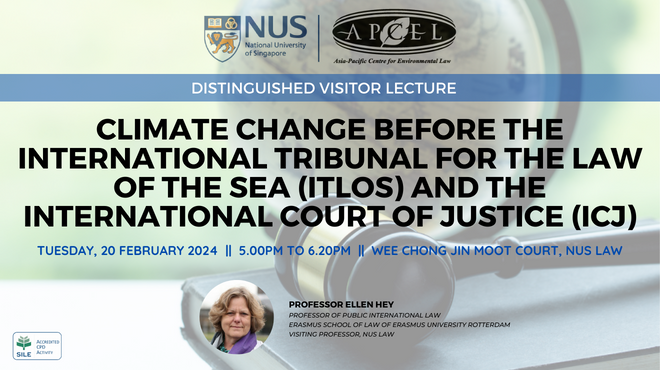
Distinguished Visitor Lecture: Climate Change before the ITLOS and ICJ





Description
ITLOS and the ICJ have been requested to deliver advisory opinions on the legal consequences of climate change. The Commission of Small Island States on Climate Change and International Law (COSIS) submitted the request to ITLOS; the United Nations General Assembly, at the initiative of Vanuatu, submitted the request to the ICJ. Both requests raise fundamental questions about the role of the international law in addressing issues that involve inequalities between states. In other words, what are the obligations of states who have emitted most greenhouse gasses, that is developed states, vis-à-vis states who have contributed very little to climate change but who are now suffering the consequences of climate change, in particular small island states? The request submitted to ITLOS focuses on the United Nations Convention on the Law of the Sea (LOSC). The request submitted to the ICJ takes a broader approach. It asks the Court to consider the obligations of states in the light of the United Nations Charter, human rights law, the climate change regime, international environmental law and the LOSC. Moreover, it asks the Court to consider the consequences of a violation of any of the rules involved vis-à-vis other states, in particular small island developing states, and peoples and individuals part of the present and future generations. This last question entails that the Court is asked to address the law on state responsibility and whether this body of law includes duties that a state owes a group of states or the international community as a whole, a much-debated topic among international legal scholars. ITLOS is expected to deliver its advisory opinion in spring/summer of 2024; the ICJ is to receive written submissions in spring 2024. The lecture will explore the thorny issues raised by these two advisory opinions.
ABOUT THE SPEAKER
Ellen Hey is Professor of Public International Law at Erasmus School of Law of Erasmus University Rotterdam, Adjunct Professor at the Norwegian Center for the Law of the Sea (NCLOS) at UiT – The Arctic University of Norway, and Advisor to the Centre for Environmental Law and Policy (CELP), of Columbo University, Sri Lanka. In July 2023, she delivered lectures at the Hague Academy of International Law on the topic ‘Making Sense of Soft Law’. She holds degrees from Utrecht University and the University of Wales and an Honorary Doctorate from Stockholm University. She was a Visiting Professorial Fellow at the University of New South Wales and a Visiting Scholar at K.G. Jebsen Center for the Law of the Sea at UiT, now NCLOS. She was a member of the Aarhus Convention Compliance Committee, a legal advisor to the government of the Netherlands, and has worked as a consultant for various international organizations. Her research interests include international law and the environment, the law of the sea, and international institutional law. Ellen Hey grew up in The Netherlands, Egypt, and Venezuela.
TERMS AND CONDITIONS
1. Fees (where applicable) are to be paid before the commencement of the event with exception of e-invoices.
2. Fees paid are non-refundable.
3. Registration is transferable within the same organisation if the request is made at least one week in advance of the event.
4. By filling up this Registration Form,i. Participants agree and consent that their personal data provided in this form may be collected, used, processed and disclosed by NUS and the event organisers for the purposes of processing their registration, in accordance with the Personal Data Protection Act 2012 and all subsidiary legislation related thereto. In respect to disclosure, NUS may disclose participants personal data to third parties (which may be in or outside of Singapore) where necessary for such purposes.ii. Participants will also consent to NUS taking photographs and videos for the purposes of event reporting, marketing, publicity, and media/social media. Participants further consent to NUS disclosing such photographs and videos to third party media entities (whether in Singapore or otherwise) for publicity purposes and NUS may identify them by name.iii. NUS Law School and designated event organisers reserve the right to alter any of the programme or other arrangements for this event, including cancellation or postponement of the event, should circumstances so warrant.
Date and Time
Tuesday, 20th February 2024 5:00PM GMT+08:00
to
Tuesday, 20th February 2024 6:20PM GMT+08:00
Organisation
Faculty of Law
Contact Email
lawapcel@nus.edu.sg
Location
Wee Chong Jin Moot Court (Block B Level 1), 469 Bukit Timah Road
Schedule
- 20/02/2024 16:30Registration
- 20/02/2024 17:00Distinguished Visitor Lecture by Professor Ellen Hey: Climate Change before the International Tribunal for the Law of the Sea (ITLOS) and the International Court of Justice (ICJ)
- 20/02/2024 18:00Q&A moderated by Assoc. Prof. Jolene Lin
- 20/02/2024 18:20Light refreshments