Description
Unbrowse
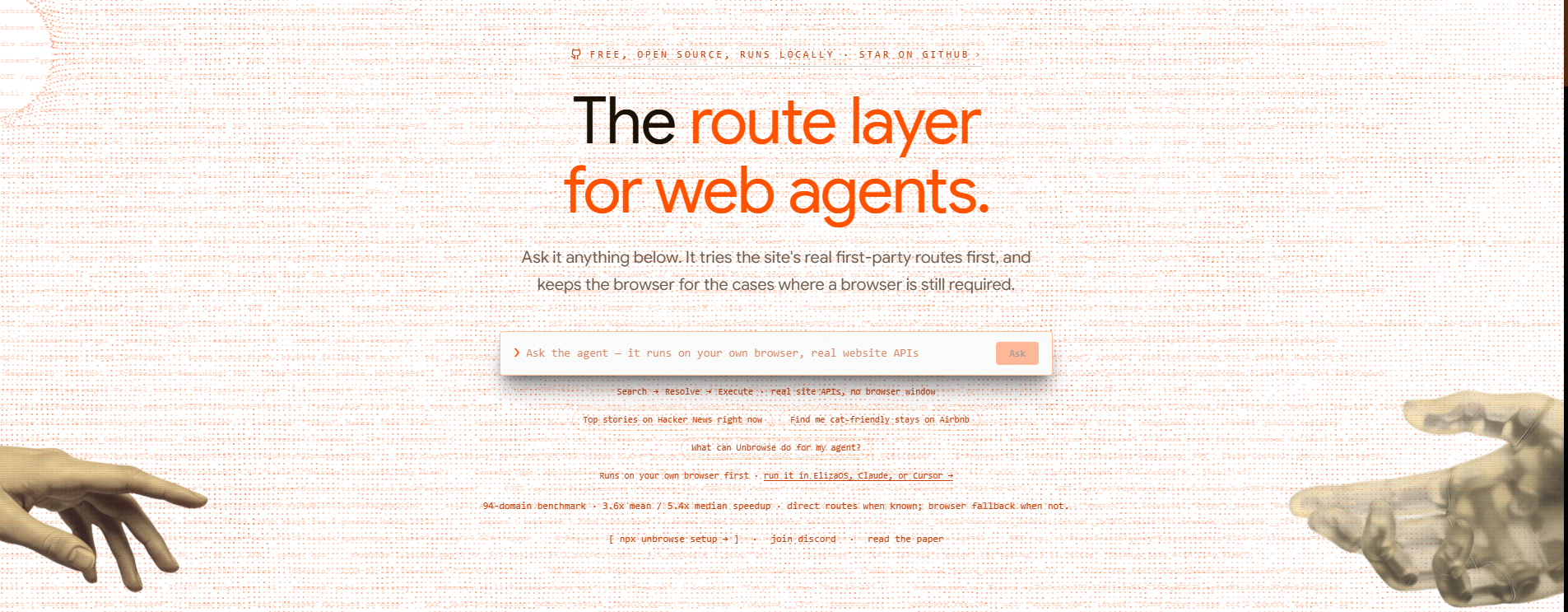
Turn websites into reusable machine routes for the agentic internet.
AI agents increasingly need to search, retrieve information, and transact across the web. But most websites are still designed for human browsing, not machine interaction.
The Challenge
Today, an AI agent typically has to:
- Launch a browser
- Render the webpage
- Parse thousands of page elements
- Navigate buttons, menus, and interfaces
- Rediscover how the same website works every time
This adds unnecessary time, cost, and complexity to every interaction.
The Unbrowse Approach
Unbrowse takes a different approach. It discovers the underlying machine route behind a website interaction once, then converts it into a reusable pathway that other AI agents can call directly.
Instead of repeatedly navigating the visual website, agents can access the information they need through a structured machine route.
No pixels. No buttons. No repeated browser navigation.
The result is faster, lower-cost, and more reliable web access designed specifically for AI agents.
How It Works
Discover the route
- Unbrowse identifies how a website retrieves or submits the information required for a particular task.
Convert interaction into a machine route
- The discovered pathway is transformed into a reusable structured route.
Return structured data
- Instead of rendering an entire webpage, the agent receives structured
JSONcontaining the information it needs.
- Instead of rendering an entire webpage, the agent receives structured
Reuse the route
- Once a pathway has been discovered and validated, future agents can call it without relearning the website from scratch.
Every successful route therefore has the potential to make the next machine interaction faster.
Browser vs. Unbrowse
Traditional Browser Execution
- Speed: Approximately 10 seconds
- Cost: Approximately US$0.30 per action
- Website learning: Relearns the website every session
- Execution method: Renders pages and parses
DOM - Designed for: Human interaction
Unbrowse Routed Execution
- Speed: Less than 1 second
- Cost: Approximately US$0.005 per action
- Website learning: Route can be reused
- Execution method: Returns structured
JSON - Designed for: Machine interaction
In short: Unbrowse replaces repeated browser navigation with a reusable machine route that is faster, cheaper, and designed for AI agents.
The project deck reports 1,021 agents deployed, more than 2 million API verifications, and approximately 60x lower execution cost through routed interaction.
What Makes Unbrowse Different
- Machine-native rather than browser-native
- Discover once, reuse repeatedly
- Structured
JSONinstead of rendered webpages - Lower latency and computational overhead
- Shared routes that become more useful as agents use them
- Infrastructure that can improve through repeated machine interaction
Unbrowse changes the underlying abstraction. Instead of asking AI to become better at clicking websites, it asks a more fundamental question:
Why It Matters
As autonomous agents become more capable, web interaction becomes an infrastructure problem.
An agent that repeatedly launches browsers, parses interfaces, and navigates human-designed workflows carries unnecessary latency, cost, and fragility into every task.
Unbrowse aims to create a reusable machine-access layer for the web.
For developers, that means faster and potentially cheaper agents. For AI platforms, it creates reusable infrastructure. For the wider web, it points towards an internet that can serve both humans and machines natively.
Built For
- AI agents
- Agentic commerce
- AI research assistants
- Workflow automation
- Developer platforms
- Machine-to-machine applications
- Enterprise AI systems requiring web data
The Pitch
Google indexed the web for humans. Unbrowse is routing it for machines — transforming repeated browser navigation into fast, reusable machine pathways.
Project Members
Media Links
View HomepageImages